

Why Booty Bands Improve Control — Not Just Strength
The Missing Conversation in Strength Training
When most people think about exercise, they focus on effort. More resistance. More repetitions. More intensity.
But strength is not fully defined by how powerfully you move upward. It is also revealed by how well you control the way down.
The lowering phase of movement, known as the eccentric phase, is where coordination, stability, and joint health are truly tested.
Every squat, step-down, lunge, or landing asks the body a simple question:
Can you manage force, or are you just producing it?
What Happens During the Eccentric Phase
Gravity accelerates the body downward. To control that descent, multiple systems must work together, including:
- Feet organize contact & force transfer with ground
- Hips stabilize the femur
- Pelvis maintains orientation
- Spine distributes load
- Deep core regulates internal pressure
When these systems cooperate, movement feels smooth and efficient. When they do not, the body looks for shortcuts. Often, those shortcuts appear at the knees.
Knees collapsing inward, excessive joint loading, and discomfort rarely come from weakness alone. They usually reflect a lack of coordinated stabilization.
The joints begin absorbing force that should have been managed by muscle and fascia.
Why Adding More Weight Isn’t Always the Answer
Traditional strength training often progresses by increasing load. Load can be valuable — but only when the body already knows how to organize itself.
If control is missing, heavier resistance magnifies compensation: Perhaps the hips stop contributing effectively, the trunk loses support, or excessive joint stress rises.
Many people unknowingly train strength on top of unstable movement patterns. They become stronger, but not necessarily more resilient.
How a Booty Band Changes the Equation
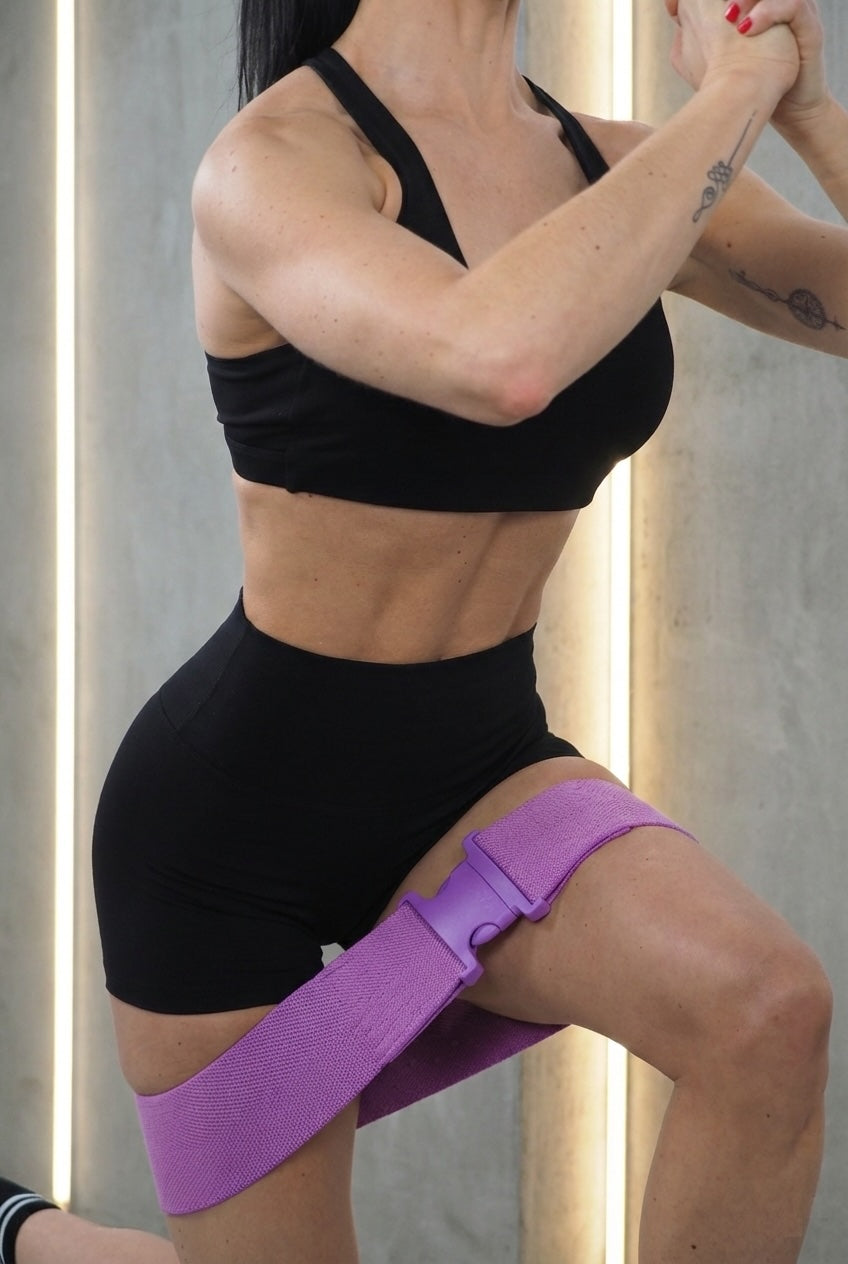
A resistance band placed around the legs introduces gentle lateral tension at the hips. This small external force creates immediate feedback for the nervous system.
Before movement even begins, the body receives a message:
Stabilize first. Then move.
As the band pulls inward into the legs:
- The gluteal stabilizers activate
- Deep hip rotators engage
- Lateral fascial lines organize
- Pelvic control improves
- Trunk stabilizers respond reflexively
Importantly, this process does not rely on conscious effort. You do not need to constantly think about “engaging your core.”
The core, muscles, nervous and fascia systems organize automatically.
Stabilization Creates Better Eccentric Control
With improved hip and trunk organization, the eccentric phase changes dramatically. Instead of dropping into movement, the body decelerates. The descent becomes controlled rather than reactive.
Force distributes across the hips, trunk, and lower limbs instead of concentrating at vulnerable joints. Muscles absorb load. Fascia stores elastic energy. Joints experience guidance instead of stress.
This is why booty bands often feel both safer and more demanding at the same time. The challenge is neurological before it is muscular.
A Pilates Perspective on Strength
Joseph Pilates emphasized control long before modern fitness culture focused on intensity. His work was not simply about strengthening muscles. It was about organizing movement.
A band around the legs reconnects the limbs to the center of the body. It encourages cooperation between hips, spine, breath, and balance.
The exercise becomes less about forcing motion and more about managing force. You are not just strengthening the glutes. You are improving how the entire system works together.
Control Before Load
One of the most effective progressions in training is often overlooked:
Control → Coordination → Strength → Power
Many people attempt to skip directly to strength or power. But when control comes first, strength develops on a stable foundation. This approach reduces unnecessary joint stress while improving long-term performance.
It bridges the gap between rehabilitation and athletic training — allowing people to move confidently whether they are recovering from injury, improving fitness, or preparing for sport.
Training for Longevity
Exercise should not only prepare us for today’s workout. It should prepare us for decades of movement.
- Walking well.
- Climbing stairs easily.
- Changing direction confidently.
- Maintaining independence and resilience over time.
Booty bands are effective not because they are lighter than weights, but because they help teach the body how to receive force safely.
True strength is not only the ability to create force, it is also the ability to control it.
Strength Without Collapse
When stabilization improves, movement becomes quieter, smoother, and more efficient. The body stops fighting itself. The eccentric phase, once the weakest link in a movement, becomes a place of intelligence and control.
In many ways, this is the goal of training. Not simply working harder, but moving better under increasing demand.
Copyright Matthew Carney 2026